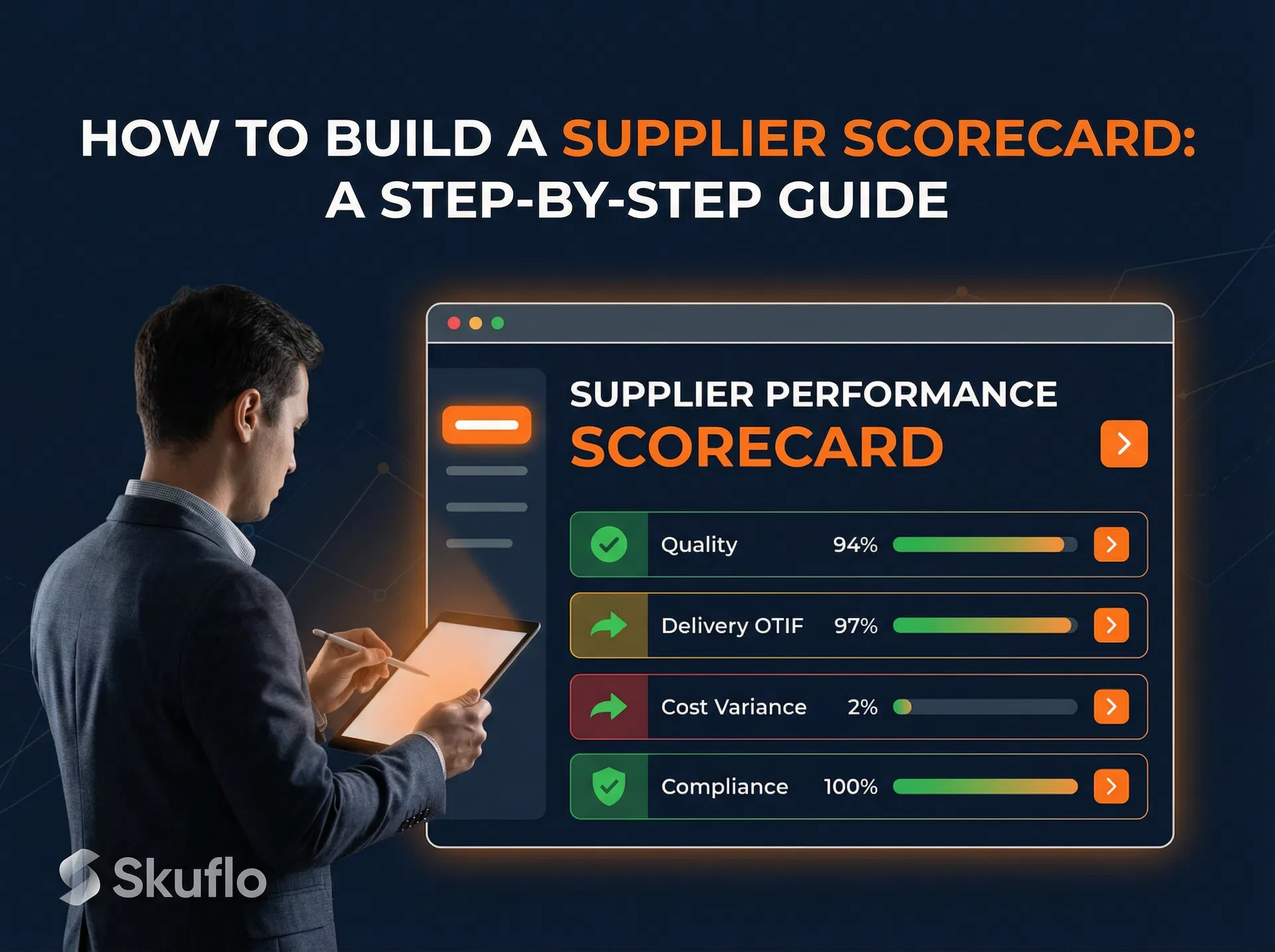
A supplier scorecard is one of the highest-leverage tools in supply chain management. It transforms vague impressions about supplier performance into structured, comparable data — enabling procurement teams to have objective conversations, make evidence-based sourcing decisions, and build stronger supplier relationships over time.
Yet despite their value, most businesses either don't have a supplier scorecard at all, or have one that's so complex it never gets used consistently. This guide walks you through building a supplier scorecard that is rigorous enough to be meaningful and simple enough to be sustainable.
What Is a Supplier Scorecard?
A supplier scorecard is a structured framework for evaluating and tracking supplier performance across a defined set of criteria. It typically assigns numerical scores to key performance indicators (KPIs), aggregates them into an overall rating, and tracks changes over time to identify trends.
The best supplier scorecards serve three purposes simultaneously: they give suppliers clear expectations of what "good" looks like, they give procurement teams objective data for sourcing decisions, and they create a shared language for supplier development conversations.
A supplier audit is a point-in-time assessment of a supplier's systems and processes. A supplier scorecard is an ongoing measurement of actual performance outcomes. Both are valuable — but scorecards are more operationally useful because they reflect what suppliers actually deliver, not just what they say they do.
Step 1: Define Your Evaluation Criteria
The first step is deciding what you will measure. Most supplier scorecards cover four to six core dimensions. The right dimensions depend on your industry and the criticality of the supplier, but the following framework works well for most businesses.
Quality
Quality metrics measure whether the supplier delivers products or services that meet your specifications. Common quality KPIs include defect rate (percentage of units failing inspection), return rate, and the number of quality escapes — instances where defective product reached your customer. For service suppliers, quality might be measured through error rates, rework frequency, or customer satisfaction scores.
Delivery
Delivery metrics measure whether the supplier delivers on time and in full. On-Time In-Full (OTIF) is the gold standard — it measures the percentage of orders that arrive by the agreed date and contain the correct quantity. Splitting OTIF into its components (on-time rate and in-full rate) gives you more diagnostic granularity when performance drops.
Cost
Cost metrics go beyond unit price to capture total cost of ownership. Price variance (actual vs. quoted price), invoice accuracy rate, and the frequency of unplanned cost increases are all useful signals. Some businesses also track cost competitiveness by benchmarking supplier pricing against market rates annually.
Responsiveness
Responsiveness measures how quickly and effectively a supplier communicates and resolves issues. Average response time to enquiries, time to resolve quality complaints, and lead time flexibility (the supplier's ability to accommodate urgent orders) are the most common metrics in this category.
Compliance
Compliance metrics ensure suppliers meet your regulatory, ethical, and contractual requirements. This includes documentation compliance (certificates of conformity, test reports, customs documents), sustainability certifications, and adherence to your supplier code of conduct. For regulated industries, compliance is often weighted more heavily than other dimensions.
| Dimension | Example KPIs | Typical Weight | Data Source |
|---|---|---|---|
| Quality | Defect rate, return rate, quality escapes | 30% | Goods-in inspection, returns log |
| Delivery | OTIF rate, lead time accuracy | 30% | PO system, WMS receipts |
| Cost | Price variance, invoice accuracy | 20% | ERP, accounts payable |
| Responsiveness | Response time, complaint resolution time | 10% | Email/ticket system, CRM |
| Compliance | Document compliance rate, audit findings | 10% | Document management system |
Step 2: Set Performance Thresholds
Once you have defined your KPIs, you need to establish what "good", "acceptable", and "unacceptable" performance looks like for each one. Without clear thresholds, scores are meaningless — a 95% OTIF rate might be excellent in one industry and below par in another.
A three-tier threshold model works well for most scorecards. The green threshold represents target performance — the level at which the supplier is meeting your expectations. The amber threshold represents acceptable but below-target performance — the supplier is functional but needs improvement. The red threshold represents unacceptable performance — the supplier is causing operational problems and requires immediate corrective action.
Green (Target): ≥ 95% — supplier is meeting expectations
Amber (Acceptable): 85–94% — supplier needs a performance improvement plan
Red (Unacceptable): < 85% — supplier is causing operational disruption; escalation required
Set thresholds based on your operational requirements, not arbitrary round numbers. If your production line stops when OTIF falls below 90%, your red threshold should be 90%, not 80%. Involve your operations and finance teams when setting thresholds to ensure they reflect real business impact.
Step 3: Design the Scoring Model
The scoring model translates raw KPI data into a comparable score. There are two common approaches: a weighted average model and a tiered points model.
Weighted Average Model
In a weighted average model, each KPI is scored on a consistent scale (typically 0–100 or 1–5), and the overall supplier score is calculated as the weighted average of all KPI scores. This model is intuitive and easy to explain to suppliers. The main risk is that a supplier can achieve a passable overall score while performing very poorly on one critical dimension — which is why some businesses apply a "floor rule" that automatically triggers a red rating if any single KPI falls below its red threshold, regardless of the overall score.
Tiered Points Model
In a tiered points model, each KPI earns a fixed number of points based on which threshold band it falls into (e.g., green = 3 points, amber = 2 points, red = 0 points). The total points determine the overall rating. This model is simpler to calculate and makes it easier to see at a glance which dimensions are dragging down a supplier's score.
For most businesses starting out, the weighted average model is the better choice because it is more granular and easier to benchmark over time. The tiered model works well when you have a large supplier base and need a quick, consistent way to segment suppliers into performance tiers.
Step 4: Establish Your Data Collection Process
A scorecard is only as good as the data behind it. Before you finalise your KPIs, map out where the data for each metric will come from and how frequently it can be collected. This step is where many scorecard initiatives fail — teams design an ambitious scorecard and then discover that half the data doesn't exist or requires significant manual effort to collect.
For each KPI, document the data source, the collection frequency, and the person responsible for collecting it. Prioritise KPIs where data is already captured in your ERP, WMS, or procurement system — these can be automated and will be the most reliable. KPIs that require manual data entry are prone to inconsistency and should be minimised, especially in the early stages of your scorecard programme.
If data gaps exist, consider whether you can close them through system configuration (e.g., adding a delivery date field to your PO system) or whether you need to accept a simpler proxy metric until better data is available. A scorecard with five well-measured KPIs is far more valuable than one with ten KPIs where half the data is unreliable.
Step 5: Determine Review Frequency
Supplier scorecards should be reviewed regularly, but the right frequency depends on the supplier's criticality and the volume of transactions. A tiered review schedule works well for most businesses.
Strategic suppliers — those representing significant spend or supplying critical components — should be reviewed monthly. Monthly reviews allow you to catch performance trends early and intervene before problems become serious. They also signal to the supplier that you are actively monitoring their performance, which in itself tends to improve results.
Preferred suppliers — those with good track records and moderate spend — can be reviewed quarterly. Quarterly reviews are sufficient to track trends and identify issues without creating excessive administrative burden.
Transactional suppliers — those with low spend or infrequent orders — can be reviewed annually or on a project basis. For these suppliers, a simplified scorecard with two or three KPIs is usually sufficient.
Step 6: Build the Scorecard Template
With your criteria, thresholds, scoring model, and data sources defined, you can now build the actual scorecard template. The template should be simple enough that it can be completed in under 30 minutes per supplier per review cycle — if it takes longer, it won't get done consistently.
A well-designed scorecard template includes a supplier summary section (name, category, strategic tier, review period), a KPI table with current scores and trend indicators, an overall rating with colour coding, a section for qualitative notes and context, and an action items section for any agreed improvement activities.
Include a "trend" column alongside each KPI score — a simple up/down/flat arrow showing whether performance has improved, declined, or stayed the same since the last review. Trend data is often more actionable than absolute scores, because it tells you whether a supplier is moving in the right direction.
Step 7: Conduct the First Supplier Review
The first scorecard review with a supplier is the most important one. It sets the tone for the entire programme and establishes whether suppliers see the scorecard as a collaborative tool or a compliance exercise. How you conduct this review will determine whether suppliers engage constructively or become defensive.
Before the review, share the scorecard methodology with the supplier in advance. Explain the KPIs, the thresholds, and how the overall score is calculated. Suppliers should never see their score for the first time in the review meeting — this creates a defensive reaction that makes productive conversation difficult.
In the review itself, start with what's going well before discussing areas for improvement. For any KPI in the amber or red zone, focus on root cause analysis rather than blame. The goal is to understand why performance has fallen short and agree on specific, time-bound actions to address it. Document these actions in the scorecard and follow up on them in the next review cycle.
Step 8: Automate and Scale
Once your scorecard process is running smoothly with a handful of suppliers, the next step is to automate data collection and scale the programme across your full supplier base. Manual scorecards work for small supplier bases but become unsustainable as the number of suppliers grows.
Modern procurement platforms and supplier management systems can automate much of the data collection, calculation, and reporting involved in supplier scorecarding. Integration with your ERP and WMS allows OTIF, defect rate, and invoice accuracy data to flow directly into the scorecard without manual entry. Automated alerts can notify procurement managers when a supplier's score drops below a threshold, enabling faster intervention.
When scaling, resist the temptation to create a single universal scorecard for all suppliers. Different supplier categories have different performance priorities — a raw material supplier should be evaluated differently from a logistics provider or a contract manufacturer. Maintain category-specific scorecard templates that share a common structure but have KPIs and thresholds tailored to the specific supplier type.
Common Supplier Scorecard Mistakes to Avoid
Even well-designed scorecards can fail in practice. The most common mistake is measuring too many KPIs. A scorecard with fifteen metrics creates data collection burden and makes it hard for suppliers to know what to prioritise. Start with five to seven KPIs and add more only when the programme is running smoothly.
A second common mistake is failing to share the scorecard with suppliers. Some procurement teams use scorecards purely as internal tools, never sharing results with suppliers. This misses the primary value of the scorecard — it is most powerful as a shared language for supplier development conversations. Suppliers who receive regular, transparent feedback consistently outperform those who don't.
A third mistake is treating the scorecard as a static document. Business priorities change, and your scorecard should evolve with them. Review your KPIs and thresholds annually to ensure they still reflect your operational requirements. If a KPI is consistently green across all suppliers, it may no longer be differentiating — consider replacing it with a more challenging metric.
Integrating Scorecards with Sourcing Decisions
The full value of a supplier scorecard is realised when it is integrated into sourcing and contract renewal decisions. Scorecard data should be a primary input when deciding whether to renew a supplier contract, increase or decrease volume allocation, or add a supplier to a preferred list.
A tiered supplier classification system — where suppliers are categorised as Strategic, Preferred, Approved, or Under Review based on their scorecard performance — provides a clear framework for these decisions. Strategic suppliers receive the most investment in relationship development. Suppliers in the Under Review tier are given a defined period to improve their scores before a sourcing decision is made.
Once your scorecard programme is established, the next step is building a structured supplier onboarding process to ensure new suppliers understand your performance expectations from day one. See our guide to supplier relationship management for a framework that covers the full supplier lifecycle.
Conclusion
A supplier scorecard is not a bureaucratic compliance exercise — it is one of the most effective tools available for improving supply chain performance. When designed well and used consistently, it transforms supplier relationships from reactive problem-solving into proactive performance management.
The eight steps in this guide — defining criteria, setting thresholds, designing the scoring model, establishing data collection, determining review frequency, building the template, conducting reviews, and automating at scale — give you a complete framework for building a supplier scorecard programme that delivers measurable results.
Start simple. A scorecard with five well-measured KPIs, reviewed consistently with your top ten suppliers, will deliver more value than a complex system that never gets used. Build the habit first, then add sophistication as the programme matures.