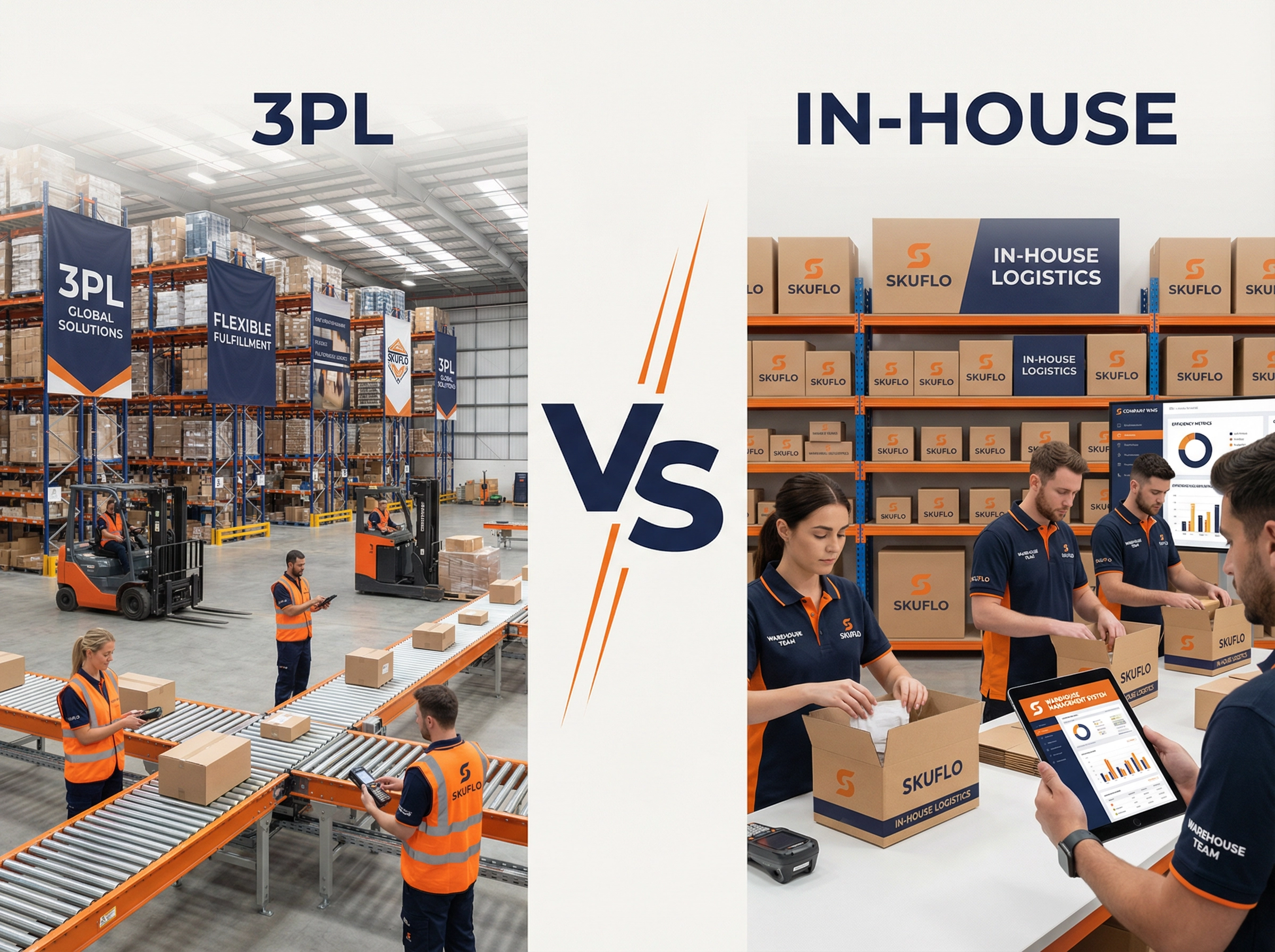
The decision to outsource warehousing to a third-party logistics provider or keep it in-house is one of the most consequential choices in supply chain strategy. It affects your cost structure, your operational flexibility, your customer experience, and your ability to scale. Get it right and you gain a durable competitive advantage. Get it wrong and you either overpay for flexibility you do not need, or lock yourself into a cost structure that cannot grow with your business.
This guide cuts through the noise. It explains what 3PL and in-house warehousing actually look like in practice, where each model excels and where it breaks down, and how to build a decision framework that fits your specific situation — not a generic checklist that ignores the variables that matter most.
What Is 3PL Warehousing?
A third-party logistics provider (3PL) is a company that manages some or all of a business's logistics operations on its behalf. In the warehousing context, a 3PL receives your inventory, stores it in its own facilities, picks and packs orders, and ships them to your customers or retail partners. You pay for the services you use — typically a combination of receiving fees, storage fees (charged per pallet or cubic metre per month), pick-and-pack fees (per order or per unit), and outbound shipping costs.
The 3PL market has grown substantially over the past decade, driven by the rise of e-commerce and the increasing complexity of multi-channel fulfilment. Today, 3PLs range from global logistics conglomerates with hundreds of facilities across dozens of countries to regional specialists with deep expertise in specific verticals — cold chain, hazardous materials, fashion, electronics, and so on.
The defining characteristic of 3PL warehousing is that the physical assets — the warehouse, the racking, the forklifts, the WMS — belong to the 3PL, not to you. You are buying access to those assets on a variable cost basis, rather than owning them outright.
What Is In-House Warehousing?
In-house warehousing means operating your own warehouse facilities, either owned or leased. You employ the warehouse staff, manage the WMS, own or lease the equipment, and bear the full cost of the operation regardless of throughput. In exchange, you have complete control over every aspect of the operation: layout, processes, technology, staffing levels, and service standards.
In-house warehousing does not necessarily mean a single facility. Large businesses often operate networks of owned or leased warehouses, sometimes supplemented by 3PL relationships for overflow capacity or specialist requirements. The defining characteristic is that the operational control — and the fixed cost base — sits with you.
The Core Trade-Off: Variable Cost vs Fixed Cost
At its heart, the 3PL vs in-house decision is a trade-off between variable and fixed cost structures. Understanding this trade-off is the foundation of any rigorous analysis.
In-house warehousing has a high fixed cost base: rent, staff salaries, equipment depreciation, utilities, insurance, and WMS licensing are all largely fixed regardless of throughput. When your volumes are high and predictable, this fixed cost base is spread across a large number of units, resulting in a low per-unit cost. When volumes are low or volatile, the fixed costs remain but the revenue to cover them shrinks — creating significant financial risk.
3PL warehousing converts most of those fixed costs into variable costs. You pay for what you use. When volumes are low, your costs fall. When volumes spike — during peak season, for example — the 3PL absorbs the capacity requirement and you pay for the additional throughput without needing to hire temporary staff or lease additional space. This variable cost structure is particularly valuable for businesses with seasonal demand patterns or unpredictable growth trajectories.
| Cost Element | In-House | 3PL |
|---|---|---|
| Warehouse space | Fixed lease / ownership cost | Variable (per pallet/m² per month) |
| Labour | Fixed salary + variable overtime | Included in per-unit fees |
| Equipment (forklifts, conveyors) | Capital expenditure or lease | Included in 3PL overhead |
| WMS technology | Licensing + implementation cost | Included or low add-on fee |
| Peak capacity | Must be built in advance | Absorbed by 3PL network |
| Minimum commitment | Full fixed cost regardless of volume | Often minimum monthly spend |
Where 3PL Warehousing Excels
Early-Stage and High-Growth Businesses
For businesses that are growing rapidly but have not yet reached the volume at which in-house warehousing becomes cost-competitive, 3PL is almost always the right choice. The capital that would otherwise be tied up in warehouse leases, equipment, and WMS implementation can be deployed into product development, marketing, or working capital. The operational complexity of running a warehouse — hiring and managing warehouse staff, maintaining equipment, managing health and safety compliance — is outsourced to specialists, freeing the leadership team to focus on growth.
Seasonal Businesses
Businesses with strongly seasonal demand patterns — retailers with a Christmas peak, garden product companies with a spring surge, fashion brands with bi-annual season launches — face a structural challenge with in-house warehousing: the facility must be sized for peak demand, but peak demand may be three to five times average demand. This means that for most of the year, the warehouse is significantly underutilised, and the fixed costs are being paid for capacity that is sitting idle.
3PL warehousing solves this problem elegantly. The 3PL's network absorbs your peak demand by drawing on capacity from other clients who are in their off-peak periods. You pay for the capacity you use, when you use it, without carrying the cost of idle capacity for the rest of the year.
Multi-Geography Fulfilment
For businesses selling across multiple geographies — particularly those expanding internationally — 3PL networks provide access to warehouse facilities in multiple locations without the capital commitment of establishing owned or leased facilities in each market. A UK-based brand expanding into the US, Germany, and Australia can use 3PL partners in each market to fulfil local orders, reducing shipping costs and delivery times without the complexity of managing three overseas warehouse operations.
Specialist Requirements
Some product categories require specialist warehousing capabilities that are expensive and complex to build in-house: temperature-controlled storage for food and pharmaceuticals, hazardous materials handling, high-security storage for electronics and luxury goods, and so on. 3PLs that specialise in these categories have already made the capital investment in specialist facilities and certifications, and can provide access to those capabilities at a fraction of the cost of building them independently.
Where In-House Warehousing Excels
High Volume, Stable Demand
At sufficient scale, in-house warehousing becomes cost-competitive with 3PL. The crossover point varies by industry and geography, but a common rule of thumb is that businesses shipping more than 500–1,000 orders per day with relatively stable demand patterns will typically find that in-house warehousing is cheaper on a per-unit basis than 3PL. At this scale, the fixed costs are spread across enough volume to be competitive, and the margin that the 3PL charges for its services — typically 15–25% on top of its own costs — becomes a significant line item.
Complex or Customised Operations
Some businesses have warehousing operations that are too complex or too customised to be handled effectively by a 3PL. Businesses with highly bespoke packaging requirements, complex kitting or assembly operations, or unique quality control processes may find that 3PLs are unable or unwilling to accommodate their requirements, or that the cost of customisation eliminates the economic advantage of outsourcing. In these cases, in-house warehousing provides the control needed to maintain operational standards.
Brand-Sensitive Customer Experience
For businesses where the unboxing experience is a core part of the brand proposition — premium DTC brands, luxury goods, subscription boxes — in-house warehousing provides the control needed to maintain consistent packaging standards. 3PLs can accommodate custom packaging requirements, but the level of attention and consistency that a dedicated in-house team provides is difficult to replicate in a shared-facility environment where your orders are processed alongside dozens of other clients.
Proprietary Data and Competitive Sensitivity
In-house warehousing keeps your inventory data, order patterns, and customer information entirely within your own systems. For businesses in competitive markets where supply chain intelligence is strategically sensitive — knowing which products are selling fastest, which suppliers are most reliable, which customers are ordering most frequently — keeping that data in-house rather than sharing it with a 3PL (who may also work with your competitors) can be a meaningful consideration.
The Hidden Costs of Each Model
Both models have costs that are easy to underestimate in a financial comparison. Understanding these hidden costs is essential to making an accurate decision.
Hidden Costs of 3PL
The headline fees — storage, pick-and-pack, receiving — are usually clear. The hidden costs are less so. Most 3PL contracts include a range of ancillary charges that can add 20–40% to the headline rate: minimum monthly fees, special handling charges for non-standard items, returns processing fees, account management fees, IT integration fees, and charges for ad hoc services like relabelling or repackaging. Carefully reading and modelling the full fee schedule — including the charges that apply when things go wrong — is essential before signing a 3PL contract.
There is also the cost of the relationship itself. Managing a 3PL relationship requires ongoing attention: reviewing invoices, resolving discrepancies, monitoring service levels, managing escalations. For businesses with complex operations, this management overhead can be substantial — equivalent to a part-time or full-time headcount.
Hidden Costs of In-House Warehousing
The most commonly underestimated cost of in-house warehousing is the management bandwidth it consumes. Running a warehouse is a full-time operational challenge: recruiting and retaining warehouse staff (in a tight labour market), managing health and safety compliance, maintaining equipment, handling peak season staffing, and continuously improving processes. For businesses whose core competency is not logistics, this management burden can be a significant drag on leadership attention and organisational capability.
There is also the opportunity cost of capital. The capital tied up in warehouse leases, equipment, and WMS implementation could alternatively be deployed into higher-return activities. For high-growth businesses, the opportunity cost of capital is often the most compelling argument for 3PL — even if the direct cost comparison is close.
A Decision Framework: Five Questions to Ask
Rather than a generic checklist, the following five questions provide a structured framework for making the 3PL vs in-house decision in the context of your specific business.
1. What is your current order volume, and how predictable is your growth trajectory?
If you are shipping fewer than 300–500 orders per day and your growth trajectory is uncertain, 3PL is almost certainly the right choice. The variable cost structure protects you against downside scenarios, and the capital flexibility supports upside growth. If you are shipping more than 1,000 orders per day with a stable demand pattern, the economics of in-house warehousing become compelling. Between these thresholds, the answer depends on the other four questions.
2. How seasonal is your demand?
If your peak-to-trough demand ratio is greater than 2:1, 3PL is likely to be more cost-effective even at relatively high volumes, because the cost of carrying idle in-house capacity through the off-peak period is substantial. If your demand is relatively flat year-round, the seasonal flexibility argument for 3PL is weaker, and the fixed-cost efficiency of in-house warehousing becomes more attractive.
3. How complex and customised is your warehousing operation?
If your operation involves standard pick-and-pack with relatively simple packaging requirements, a 3PL can almost certainly handle it competently. If your operation involves complex kitting, bespoke packaging, specialist handling requirements, or highly customised quality control processes, the probability of finding a 3PL that can meet your standards decreases, and the case for in-house control strengthens.
4. How important is the fulfilment experience to your brand?
If your customers' experience of your brand is significantly shaped by the quality of the unboxing experience — packaging design, personalisation, consistency — in-house warehousing provides the control to maintain those standards reliably. If your fulfilment is largely functional (B2B shipments, commodity products), the brand experience argument for in-house is weaker.
5. What is your capital allocation priority?
If you are in a capital-intensive growth phase — investing heavily in product development, marketing, or geographic expansion — the capital flexibility of 3PL is valuable even if the direct cost comparison is close. If you are in a mature, profitable phase where capital efficiency is the priority, the lower per-unit cost of in-house warehousing at scale becomes more attractive.
The Hybrid Model: Getting the Best of Both
Many businesses find that the binary choice between 3PL and in-house warehousing is a false dichotomy. A hybrid model — maintaining an in-house warehouse for core, predictable volume while using 3PL for overflow capacity, specialist requirements, or geographic expansion — can capture the cost efficiency of in-house warehousing at the base volume while retaining the flexibility of 3PL for variable demand.
The hybrid model works best when the in-house and 3PL operations are managed through a single inventory management system that provides real-time visibility across all locations. Without unified visibility, the hybrid model creates the worst of both worlds: the complexity of managing multiple operations without the full cost benefits of either.
This is where a modern warehouse management system (WMS) becomes critical. A WMS that integrates with both in-house operations and 3PL portals — providing a single view of stock across all locations, automating allocation decisions, and generating consolidated reporting — is the enabling technology that makes the hybrid model operationally viable.
Technology's Role in the Decision
The technology landscape has changed the economics of both models in important ways. Modern cloud-based WMS platforms have significantly reduced the cost and complexity of implementing in-house warehouse technology, lowering the barrier to in-house operations for mid-market businesses. At the same time, 3PL portals and EDI integrations have made it easier to maintain real-time visibility into 3PL operations, reducing one of the traditional disadvantages of outsourcing.
The most important technology consideration in the 3PL vs in-house decision is integration capability. Whether you choose 3PL, in-house, or a hybrid model, your warehousing operation needs to integrate seamlessly with your order management system, your e-commerce platform, your ERP, and your carrier network. Businesses that choose 3PL partners with limited integration capability — or in-house WMS platforms that cannot connect to their other systems — end up with manual data entry, delayed visibility, and operational errors that erode the cost advantages of their chosen model.
When to Switch Models
The 3PL vs in-house decision is not a one-time choice. As businesses grow and their supply chain requirements evolve, the optimal model changes. The most common transition is from 3PL to in-house (or hybrid) as volumes grow and the economics of in-house warehousing improve. The trigger for this transition is typically a combination of volume growth, increasing complexity, and dissatisfaction with 3PL service levels or costs.
The transition from 3PL to in-house is operationally complex and should not be underestimated. Finding and fitting out a suitable warehouse, recruiting and training staff, implementing a WMS, and migrating inventory — all while maintaining service levels to customers — requires careful planning and typically takes 6–12 months from decision to full operation. Businesses that wait until they are already frustrated with their 3PL before starting this process often find themselves in a difficult position.
The reverse transition — from in-house to 3PL — is less common but does happen, typically in response to volume decline, geographic consolidation, or a strategic decision to focus capital on core competencies. This transition is generally less operationally complex but requires careful contract negotiation to ensure that the 3PL relationship provides the service levels and flexibility the business needs.
Conclusion
The 3PL vs in-house warehousing decision does not have a universal right answer. It depends on your volume, your demand variability, your operational complexity, your brand requirements, and your capital allocation priorities. The framework in this guide — five questions that map to the five most important decision variables — provides a structured way to reach the right answer for your specific situation.
What is clear is that the decision should be made analytically, not emotionally. The instinct to "own your operations" is understandable but can be expensive when the economics favour outsourcing. Equally, the instinct to "keep it simple" by outsourcing everything can leave significant cost savings on the table for businesses that have reached the scale at which in-house warehousing is more efficient.
Whatever model you choose, the technology that connects your warehousing operation to the rest of your supply chain is the critical enabler. Skuflo's logistics management platform integrates with both in-house WMS operations and 3PL portals, giving you a single view of inventory and fulfilment performance across your entire network. Speak to our team to see how it works in practice.