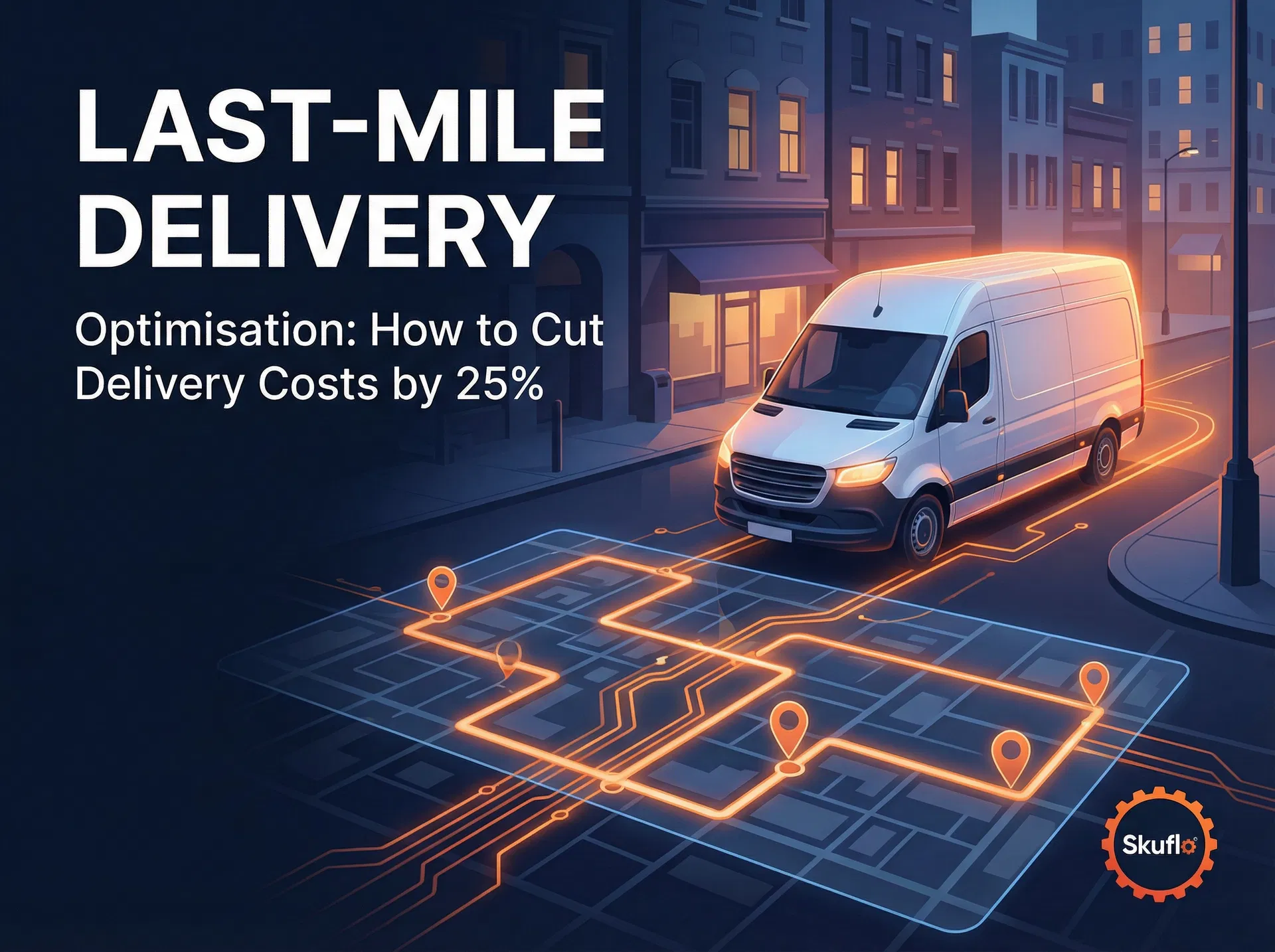
Last-mile delivery is the final leg of the supply chain — the journey from a distribution centre or fulfilment hub to the end customer's door. It is also, by a significant margin, the most expensive leg. Industry research consistently shows that last-mile delivery accounts for 53% of total shipping costs, yet it represents only a fraction of the total distance a shipment travels. For operations teams managing high-volume fulfilment, this imbalance is not just a line item — it is a strategic liability.
The good news is that last-mile costs are not fixed. Businesses that apply systematic optimisation — combining smarter routing, carrier diversification, delivery density improvements, and real-time visibility — routinely achieve cost reductions of 20–30%. This guide explains exactly how to get there, with practical frameworks you can apply regardless of whether you run your own fleet, rely on third-party carriers, or use a hybrid model.
Last-mile delivery costs average $10.10 per package in urban markets and up to $17.50 in rural areas. Failed first-attempt deliveries — which affect roughly 6–12% of all shipments — add an average of $3.50 per re-attempt. For a business shipping 10,000 parcels per month, that is $35,000 in avoidable costs every month.
Why Last-Mile Costs Are So High
Understanding the cost drivers is the prerequisite to reducing them. Last-mile delivery is expensive for three structural reasons: low delivery density, high variability, and the labour intensity of the final handoff.
Low delivery density is the core problem. A long-haul truck moving 500 pallets from a factory to a distribution centre achieves enormous economies of scale. A delivery van dropping off 80 parcels across a 40-kilometre suburban radius does not. The cost per stop is high because each stop requires navigation, parking, customer interaction, and proof of delivery — none of which scale linearly.
High variability compounds the problem. Unlike predictable B2B deliveries to fixed commercial addresses, B2C last-mile involves residential addresses, unpredictable recipient availability, access restrictions, and time-window preferences. Failed delivery attempts are expensive not just because of the re-delivery cost, but because they consume driver time, fuel, and vehicle capacity that could have been used for successful deliveries.
Labour intensity is the third driver. Driver wages, vehicle depreciation, fuel, and insurance together account for 60–70% of last-mile delivery costs. These costs are largely fixed per route, regardless of how many successful deliveries are completed. Increasing stops per route — delivery density — is therefore the single most powerful lever for reducing cost per delivery.
The Five Levers of Last-Mile Cost Reduction
Effective last-mile optimisation is not a single initiative — it is a portfolio of complementary improvements applied simultaneously. The five levers below, when combined, typically deliver 20–30% cost reduction within 6–12 months.
1. Route Optimisation: The Foundation of Efficiency
Route optimisation software calculates the most efficient sequence and path for a set of delivery stops, accounting for traffic, time windows, vehicle capacity, and driver hours. The difference between manually planned routes and algorithmically optimised routes is typically 15–25% fewer kilometres driven and 10–20% more stops per route.
Modern route optimisation platforms go beyond simple shortest-path calculations. They incorporate dynamic re-routing based on real-time traffic data, predictive time-window compliance scoring, and multi-depot optimisation for businesses with several fulfilment locations. The best platforms also learn from historical delivery data — identifying which addresses consistently require more time, which time windows have higher failure rates, and which routes are most affected by seasonal traffic patterns.
When evaluating route optimisation software, prioritise platforms that offer: API integration with your order management system for automatic stop import; real-time driver tracking with ETA updates; proof-of-delivery capture (photo, signature, barcode scan); and failed delivery workflow management with automatic re-scheduling.
2. Delivery Density: Clustering Stops to Reduce Cost Per Drop
Delivery density — the number of successful deliveries per kilometre driven — is the primary determinant of last-mile unit economics. Increasing density requires either concentrating deliveries geographically (zoning) or increasing the volume of deliveries in existing zones.
Zoning strategies assign specific postcodes or geographic areas to specific routes and delivery days. Rather than attempting to serve all areas every day, zoned delivery models concentrate volume in fewer areas per day, dramatically increasing stops per route. This approach is particularly effective for subscription-based businesses, grocery delivery, and any model where customers can be incentivised to choose a preferred delivery day.
Delivery consolidation is the B2B equivalent — batching multiple orders for the same customer or geographic cluster into a single delivery run. For businesses with high order frequency from the same customers, consolidation can reduce delivery frequency by 30–40% without impacting service levels.
Increasing stops per route from 15 to 20 (a 33% improvement in density) typically reduces cost per delivery by 20–25%, because fixed costs (driver wages, vehicle depreciation, fuel for the route) are spread across more deliveries. This is why density is the most powerful lever — it improves unit economics without requiring any reduction in absolute costs.
3. Carrier Diversification: Using the Right Carrier for Each Shipment
Most businesses default to one or two national carriers for all their last-mile delivery. This is convenient but expensive. A multi-carrier strategy — selecting the optimal carrier for each shipment based on destination, weight, time sensitivity, and cost — typically reduces blended carrier costs by 8–15%.
The key dimensions for carrier selection are:
| Dimension | What to Optimise | Typical Saving |
|---|---|---|
| Zone-based pricing | Use regional carriers for local deliveries where they undercut national rates | 12–18% on local shipments |
| Weight breaks | Match carrier rate cards to shipment weight bands to avoid dimensional weight penalties | 5–10% on heavy shipments |
| Service level | Downgrade from next-day to 2–3 day for non-urgent shipments where customers accept it | 15–25% per downgraded shipment |
| Residential surcharges | Use carriers with lower residential delivery fees for B2C-heavy routes | $0.50–$2.00 per residential stop |
Implementing a multi-carrier strategy requires a transportation management system (TMS) or carrier selection engine that can rate-shop across carriers in real time at the point of label generation. The ROI on this investment is typically achieved within 3–6 months for businesses shipping more than 500 parcels per month.
4. Failed Delivery Reduction: Eliminating the Most Expensive Cost
A failed delivery attempt is one of the most expensive events in last-mile logistics. The direct cost — driver time, fuel, vehicle wear — is significant. But the indirect costs are often larger: customer service contacts, re-delivery scheduling, customer dissatisfaction, and in some cases, returns. Reducing failed delivery rates from 10% to 4% on a 10,000-parcel-per-month operation saves approximately $21,000 per month in direct re-delivery costs alone.
The most effective interventions for reducing failed deliveries are:
Pre-delivery notifications — sending SMS or email alerts 24 hours and 2 hours before delivery, with a real-time tracking link, reduces failed attempts by 30–40%. Customers who know exactly when their delivery is arriving are far more likely to be available or to arrange an alternative.
Delivery preference capture — asking customers at checkout for a preferred delivery time window, safe place instructions, or neighbour delivery authorisation. This information, passed to the driver via the delivery app, eliminates a significant proportion of failed attempts caused by recipient unavailability.
Smart locker and PUDO networks — offering parcel locker or pick-up/drop-off (PUDO) point delivery as an alternative to home delivery eliminates the failed delivery problem entirely for customers who opt in. PUDO delivery also typically costs 20–35% less than home delivery, making it a win on both dimensions.
5. Real-Time Visibility: The Enabler of All Other Optimisations
Real-time visibility — knowing where every vehicle and every parcel is at every moment — is not just a customer experience feature. It is the operational foundation that makes all other optimisations possible. Without visibility, you cannot identify which routes are underperforming, which drivers are deviating from optimised paths, or which deliveries are at risk of failure.
A modern last-mile visibility platform should provide: GPS tracking of all vehicles with 30-second or better update frequency; real-time ETA recalculation as routes deviate from plan; exception alerting for late departures, missed time windows, and failed deliveries; and performance dashboards showing cost per delivery, on-time rate, and stops per route by driver, route, and time period.
The data generated by a visibility platform is also the raw material for continuous improvement. Businesses that systematically analyse their delivery performance data — identifying patterns in failed deliveries, route inefficiencies, and carrier performance — achieve compounding improvements over time that far exceed the initial gains from any single optimisation initiative.
Building a Last-Mile Optimisation Roadmap
The five levers above are most effective when implemented in a structured sequence. The following 90-day roadmap reflects the order in which most operations teams achieve the fastest return on investment.
Days 1–30 (Foundation): Establish baseline metrics — cost per delivery, failed delivery rate, stops per route, on-time delivery rate. Implement real-time vehicle tracking if not already in place. Audit carrier contracts and identify rate card anomalies.
Days 31–60 (Quick Wins): Deploy route optimisation software and run pilot on highest-volume routes. Implement pre-delivery SMS notifications. Begin carrier rate-shopping on a subset of shipments. Target: 10–15% cost reduction on pilot routes.
Days 61–90 (Scale): Roll out route optimisation across all routes. Launch delivery preference capture at checkout. Introduce zoning for eligible delivery areas. Negotiate revised carrier contracts based on volume data. Target: 20–25% blended cost reduction.
Technology Stack for Last-Mile Optimisation
Implementing the five levers requires the right technology foundation. The core components of a last-mile optimisation stack are:
Order Management System (OMS) — the source of truth for all orders, providing the delivery address, weight, dimensions, and service level for each shipment. The OMS feeds the route optimisation engine and carrier selection system.
Transportation Management System (TMS) — manages carrier relationships, rate cards, and shipment booking. A TMS with multi-carrier rate shopping capability is the primary tool for carrier cost optimisation.
Route Optimisation Engine — calculates optimal delivery sequences and routes. Can be a standalone platform (e.g., Circuit, OptimoRoute, Route4Me) or a module within a broader TMS or WMS.
Driver Mobile App — provides drivers with turn-by-turn navigation, delivery instructions, and proof-of-delivery capture. Feeds real-time location data back to the visibility platform.
Customer Notification System — sends automated pre-delivery notifications and real-time tracking links. Can be integrated into the OMS or TMS, or implemented as a standalone service.
For businesses already using a warehouse management system (WMS), many of these capabilities can be accessed through integrations rather than standalone platforms. Modern WMS platforms increasingly offer native last-mile optimisation modules or pre-built integrations with leading TMS and route optimisation providers.
Measuring Success: The KPIs That Matter
Last-mile optimisation is an ongoing process, not a one-time project. The following KPIs provide the measurement framework for continuous improvement:
| KPI | Definition | Target Benchmark |
|---|---|---|
| Cost per delivery | Total last-mile cost ÷ successful deliveries | Reduce by 20–25% within 6 months |
| First-attempt delivery rate | Successful deliveries on first attempt ÷ total deliveries | >92% (industry best practice) |
| Stops per route | Average successful deliveries per vehicle per day | Increase by 15–20% within 3 months |
| On-time delivery rate | Deliveries within promised time window ÷ total deliveries | >95% for standard, >98% for premium |
| Kilometres per delivery | Total kilometres driven ÷ successful deliveries | Reduce by 15–20% within 3 months |
| Re-delivery rate | Re-deliveries ÷ total delivery attempts | <5% (target <3% with notifications) |
Common Pitfalls to Avoid
Last-mile optimisation projects frequently underperform because of avoidable implementation mistakes. The three most common pitfalls are:
Optimising in isolation. Route optimisation that is not connected to real-time order data, carrier systems, and driver apps produces plans that look good on paper but fail in execution. Integration across the full technology stack is essential for capturing the full benefit.
Ignoring the driver experience. Route optimisation software that produces theoretically optimal routes but ignores driver knowledge, break requirements, and vehicle loading constraints will be resisted by drivers and produce worse outcomes than manually planned routes. Involve drivers in the implementation process and build in mechanisms for driver feedback.
Measuring the wrong things. Focusing exclusively on cost per delivery without tracking first-attempt delivery rate and customer satisfaction can lead to false economies. A route that is 15% cheaper but has a 20% failed delivery rate is not an improvement — it is a cost shift from visible delivery costs to invisible re-delivery and customer service costs.
The Strategic Imperative
Last-mile delivery is increasingly a competitive differentiator, not just a cost centre. Customers have been conditioned by e-commerce giants to expect fast, free, and transparent delivery. Businesses that cannot meet these expectations lose customers to competitors who can. But the businesses that win are not necessarily those with the largest logistics budgets — they are the ones that apply systematic optimisation to extract maximum efficiency from every delivery run.
A 25% reduction in last-mile delivery costs is not a theoretical target — it is a documented outcome achieved by businesses of all sizes that apply the five levers described in this guide with discipline and consistency. The technology to achieve it is accessible, the methodology is proven, and the return on investment is measurable within months. The only question is when to start.
Skuflo's logistics module provides real-time shipment visibility, multi-carrier rate shopping, and route performance analytics — the three technology foundations for last-mile cost reduction. Businesses using Skuflo's logistics platform report an average 22% reduction in last-mile delivery costs within the first six months of deployment. Request a demo to see how Skuflo can help optimise your last-mile operations.