Purchase order management software is a digital system that automates the creation, approval, tracking, and reconciliation of purchase orders (POs) across an organisation's entire procurement lifecycle. Unlike manual spreadsheet-based workflows, a dedicated PO management platform enforces approval hierarchies, maintains a real-time audit trail, and integrates with ERP, accounting, and supplier portals to eliminate duplicate data entry and reduce maverick spending.
For operations teams managing 50 or more suppliers, the difference between a manual PO process and an automated one is not merely a matter of convenience — it is a measurable driver of cost, compliance, and supplier relationship quality. According to the Institute for Supply Management (ISM), organisations that automate their purchase order workflows reduce PO processing costs by an average of 70%, from approximately $50 per manual PO to under $15 per automated PO. At scale, that arithmetic is transformative.
This guide defines what purchase order management software is, explains how it differs from adjacent tools such as ERP vendor modules and accounts payable automation, and provides a practical framework for evaluating and implementing a PO management system in 2024 and beyond.
What Is Purchase Order Management?
Purchase order management is the end-to-end process of requesting, approving, issuing, tracking, receiving, and reconciling purchase orders between a buying organisation and its suppliers. A purchase order is a legally binding commercial document that specifies the goods or services being purchased, the agreed price, the delivery date, and the payment terms.
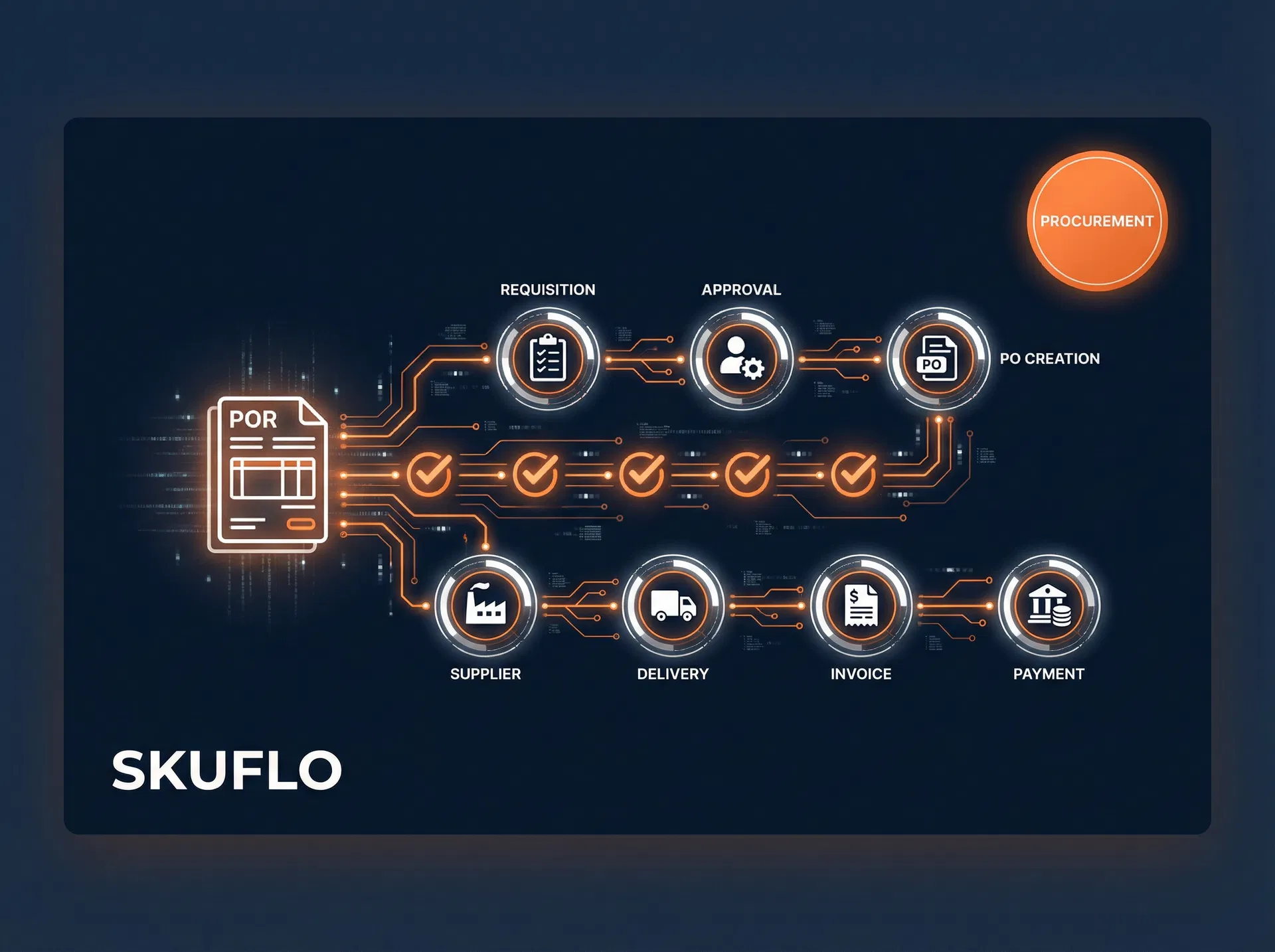
The purchase order lifecycle typically follows seven stages:
- Purchase requisition — an internal request from a department or team member to procure goods or services
- Approval workflow — the requisition is routed to one or more approvers based on spend category, amount, or supplier
- PO creation — an approved requisition generates a formal purchase order with a unique PO number
- PO transmission — the PO is sent to the supplier via email, EDI, or a supplier portal
- Order acknowledgement — the supplier confirms receipt and acceptance of the PO terms
- Goods receipt — the buying organisation records the receipt of goods or services against the open PO
- Three-way match and payment — the PO, goods receipt note (GRN), and supplier invoice are matched before payment is released
Purchase order management software automates each of these stages, replacing email chains, spreadsheets, and paper-based approvals with a structured, auditable digital workflow.
Why Purchase Order Management Matters in 2024
The business case for automating purchase order management has never been stronger. Supply chain disruptions, inflationary pressure on input costs, and increasing regulatory scrutiny of procurement practices have elevated PO management from a back-office function to a board-level priority.
The Cost of Manual PO Processing
Research by Ardent Partners, a procurement research and advisory firm, consistently finds that best-in-class procurement organisations process purchase orders in under 24 hours, while average organisations take 3–5 business days. The gap is almost entirely explained by the degree of automation in the PO workflow. Manual processes introduce delays at every stage: requisitions sit in email inboxes awaiting approval, POs are re-keyed from spreadsheets into supplier portals, and three-way matching is performed manually by accounts payable staff.
The financial consequences compound quickly. A 2023 study by Hackett Group found that organisations in the bottom quartile for PO automation spend 4.6 times more on procurement operations per $1 billion of spend than top-quartile organisations. For a mid-market company with $100 million in annual procurement spend, that gap represents $800,000 to $1.2 million in avoidable operational cost per year.
Maverick Spending and Compliance Risk
Without a structured PO management system, employees frequently bypass the procurement process entirely — ordering directly from suppliers via credit card or verbal agreement, then submitting expense claims after the fact. This "maverick spending" or "off-contract purchasing" undermines negotiated supplier agreements, creates compliance exposure, and makes it impossible to accurately forecast cash flow.
According to KPMG's Global Procurement Survey, maverick spending accounts for 20–40% of total procurement spend in organisations without automated PO workflows. A PO management system closes this gap by making the compliant path the easiest path: requisitions are submitted through the system, approvals are enforced automatically, and no payment can be processed without a matched PO.
| Metric | Manual PO Process | Automated PO Process | Improvement |
|---|---|---|---|
| Cost per PO | $45–$65 | $8–$15 | 70–80% reduction |
| PO cycle time | 3–5 business days | 4–8 hours | 85–95% faster |
| Maverick spend rate | 20–40% | 3–8% | 75–85% reduction |
| Invoice matching accuracy | 72–78% | 95–99% | 20–35% improvement |
| Supplier on-time delivery | 68–74% | 82–91% | 15–25% improvement |
Sources: Ardent Partners State of ePayables 2023; Hackett Group Procurement Benchmark 2023; ISM Report on Business
Key Features of Purchase Order Management Software
Not all PO management systems are created equal. The following features distinguish enterprise-grade platforms from basic tools:
1. Configurable Approval Workflows
The approval workflow engine is the heart of any PO management system. Best-in-class platforms support multi-level approval chains based on spend thresholds, cost centres, spend categories, and supplier risk ratings. Approvals should be actionable directly from email notifications without requiring the approver to log into the system — a feature that dramatically reduces approval cycle times.
2. Supplier Portal Integration
A supplier-facing portal allows vendors to acknowledge POs, submit invoices, update delivery status, and raise queries without requiring phone calls or email exchanges. Supplier portals reduce inbound supplier enquiries by 40–60% and accelerate the goods receipt and invoice matching process significantly.
3. Three-Way Matching Automation
Three-way matching — comparing the purchase order, goods receipt note, and supplier invoice — is the primary control that prevents overpayment and fraud. Manual three-way matching is time-consuming and error-prone; automated matching flags discrepancies instantly and routes exceptions to the appropriate reviewer, allowing straight-through processing for clean invoices.
4. Real-Time Spend Visibility
A PO management system should provide real-time dashboards showing committed spend (approved POs not yet invoiced), accrued spend (goods received but not yet invoiced), and actual spend (invoices matched and approved for payment). This three-layer view gives finance teams the visibility they need for accurate cash flow forecasting and month-end close.
5. ERP and Accounting Integration
PO data must flow bidirectionally with the organisation's ERP (SAP, Oracle, Microsoft Dynamics, NetSuite) and accounting system (Xero, QuickBooks, Sage). Without native integration, data is re-keyed manually, creating reconciliation errors and delaying financial reporting.
6. Supplier Performance Tracking
Leading PO management platforms capture delivery performance data automatically — on-time delivery rate, fill rate, quality rejection rate — and surface it in supplier scorecards. This data transforms supplier reviews from subjective conversations into evidence-based negotiations.
7. Audit Trail and Compliance Reporting
Every action in the PO lifecycle — creation, approval, amendment, cancellation — should be logged with a timestamp and user identity. A complete audit trail is essential for SOX compliance, ISO 9001 certification, and internal audit requirements.
PO Management Software vs. ERP Procurement Modules
A common question from operations teams evaluating their options is whether to use the procurement module bundled with their existing ERP or invest in a dedicated PO management platform. The answer depends on the organisation's scale, supplier complexity, and the maturity of its procurement processes.
| Capability | ERP Procurement Module | Dedicated PO Management Software |
|---|---|---|
| Approval workflow flexibility | Limited, often requires customisation | Highly configurable out of the box |
| Supplier portal | Basic or absent | Full-featured, self-service |
| Implementation time | 6–18 months | 4–12 weeks |
| Total cost of ownership | High (licences + customisation + maintenance) | Moderate (SaaS subscription) |
| Mobile accessibility | Limited | Native mobile apps |
| Supplier onboarding | Manual, IT-dependent | Self-service, automated |
| Analytics and reporting | Standard reports, limited customisation | Real-time dashboards, custom reports |
For organisations with fewer than 50 suppliers and straightforward procurement workflows, an ERP procurement module may be sufficient. For organisations managing 50+ suppliers, complex multi-tier supply chains, or high-volume PO processing (500+ POs per month), a dedicated PO management platform will deliver faster time-to-value and a significantly better user experience for both buyers and suppliers.
How to Implement Purchase Order Management Software: A 6-Step Framework
Implementing a PO management system is a change management exercise as much as a technology deployment. The following framework has been validated across hundreds of mid-market and enterprise implementations:
Step 1: Map Your Current PO Workflow
Before selecting software, document every step in your current purchase order process — from the moment a need is identified to the moment payment is released. Identify bottlenecks, approval delays, and the points where data is re-keyed or lost. This baseline will define your requirements and serve as the benchmark against which you measure improvement post-implementation.
Step 2: Define Your Approval Matrix
Establish clear rules for who can approve purchase orders based on spend amount, spend category, and cost centre. A well-designed approval matrix balances control (ensuring appropriate oversight) with speed (avoiding unnecessary escalations that slow down routine purchases). Most organisations use a tiered structure: team leads approve up to $5,000, department heads up to $25,000, and the CFO or procurement director above that threshold.
Step 3: Onboard Your Supplier Base
Supplier onboarding is the most underestimated phase of any PO management implementation. Allocate dedicated time and resources to registering suppliers in the new system, collecting and validating banking details, and training supplier contacts on the portal. Suppliers who are not onboarded correctly will continue to submit invoices outside the system, undermining the three-way matching process.
Step 4: Configure Integrations
Connect the PO management system to your ERP, accounting platform, and any existing supplier databases. Test bidirectional data flows thoroughly before go-live — a PO created in the procurement system should appear in the ERP within minutes, and a goods receipt posted in the ERP should automatically update the open PO status in the procurement system.
Step 5: Pilot with a Single Category
Rather than attempting a big-bang rollout across all spend categories simultaneously, pilot the new system with a single, well-defined spend category — indirect procurement (office supplies, IT equipment) is a common choice because it is high-volume, low-risk, and involves a manageable number of suppliers. Use the pilot to identify configuration gaps and train internal users before expanding to strategic spend categories.
Step 6: Measure and Optimise
Define KPIs before go-live and measure them consistently: PO cycle time, PO processing cost, maverick spend rate, three-way match rate, and supplier on-time delivery. Review these metrics monthly for the first six months and use them to drive continuous improvement in your approval workflows, supplier onboarding processes, and integration configurations.
How Skuflo Supports Purchase Order Management at Scale
Skuflo's Supplier Hub includes a fully integrated purchase order management module designed for operations teams managing 50 to 500+ suppliers. Key capabilities include:
- Automated PO generation from approved requisitions, with configurable approval workflows and email-actionable approvals
- Supplier portal for PO acknowledgement, delivery status updates, and invoice submission — reducing inbound supplier queries by up to 60%
- Three-way matching engine that automatically compares POs, GRNs, and invoices, flagging discrepancies for human review
- Real-time spend dashboards showing committed, accrued, and actual spend by supplier, category, and cost centre
- ERP integration with SAP, Oracle, NetSuite, Microsoft Dynamics, and Xero via pre-built connectors
- Supplier performance scorecards capturing on-time delivery, fill rate, and quality metrics automatically from PO data
Skuflo customers typically reduce PO cycle times by 80% and maverick spend by 65% within the first 90 days of deployment. Book a demo to see the PO management module in action.
Frequently Asked Questions
What is the difference between a purchase order and an invoice?
A purchase order (PO) is issued by the buyer to the supplier before goods or services are delivered. It specifies what is being ordered, at what price, and under what terms. An invoice is issued by the supplier to the buyer after goods or services have been delivered, requesting payment. In a three-way match process, the PO, the goods receipt note (GRN), and the invoice are compared to verify that what was ordered, received, and billed are consistent before payment is released.
How long does it take to implement purchase order management software?
Implementation timelines vary by platform and organisational complexity. Cloud-based SaaS PO management systems typically go live in 4–12 weeks for mid-market organisations. ERP-embedded procurement modules take significantly longer — 6–18 months — due to customisation and data migration requirements. The most time-consuming phase is usually supplier onboarding, which should be planned for 2–4 weeks regardless of the platform chosen.
What is three-way matching in purchase order management?
Three-way matching is the process of comparing three documents before releasing payment to a supplier: the purchase order (what was ordered), the goods receipt note or GRN (what was received), and the supplier invoice (what is being charged). When all three documents agree on quantity, price, and terms, the invoice is approved for payment automatically. When discrepancies are found, the invoice is flagged for manual review. Three-way matching is the primary control against overpayment, duplicate payment, and invoice fraud.
Can purchase order management software integrate with my existing ERP?
Yes. Most enterprise PO management platforms offer pre-built connectors for major ERP systems including SAP S/4HANA, Oracle Fusion, Microsoft Dynamics 365, NetSuite, and Sage. Integration typically covers bidirectional PO data synchronisation, goods receipt posting, and invoice matching. For less common ERP systems, API-based integration is usually available. Confirm ERP compatibility and integration depth before selecting a vendor.
What is maverick spending and how does PO software prevent it?
Maverick spending (also called off-contract or rogue purchasing) occurs when employees buy goods or services without going through the approved procurement process — typically using a personal credit card or verbal agreement with a supplier. PO management software prevents maverick spending by making the compliant path the easiest path: all purchase requests are submitted through the system, approvals are enforced automatically, and accounts payable is configured to only process invoices that are matched to an approved PO. Organisations that implement PO management software typically reduce maverick spending from 20–40% of total procurement spend to under 8%.
Is purchase order management software suitable for small businesses?
PO management software is most impactful for organisations processing 100 or more purchase orders per month or managing 20 or more active suppliers. Below that threshold, a well-structured spreadsheet template may be sufficient. For growing businesses approaching these thresholds, implementing a PO management system early — before procurement complexity becomes unmanageable — is significantly easier than retrofitting one after the fact. Most modern SaaS PO management platforms are priced on a per-user or per-PO basis, making them accessible to businesses of all sizes.
What is a blanket purchase order?
A blanket purchase order (BPO) is a long-term agreement with a supplier that covers multiple deliveries of the same goods or services over a defined period, typically 6–12 months. Rather than issuing a new PO for each delivery, the buyer issues a single blanket PO with a total value or quantity cap, and individual delivery releases are made against it. Blanket POs reduce administrative overhead for high-frequency, recurring purchases and allow buyers to negotiate volume discounts with suppliers.
How does purchase order management software improve supplier relationships?
PO management software improves supplier relationships in three primary ways. First, it provides suppliers with clear, structured POs that eliminate ambiguity about what is being ordered and under what terms. Second, supplier portals give vendors real-time visibility into PO status, delivery schedules, and invoice payment status — reducing the volume of inbound enquiries and improving supplier satisfaction. Third, automated performance tracking provides objective data for supplier reviews, enabling more productive, evidence-based conversations about delivery performance, quality, and pricing.
Conclusion
Purchase order management software is not a luxury for large enterprises — it is a foundational operational capability for any organisation that procures goods or services from multiple suppliers. The combination of automated approval workflows, supplier portal integration, three-way matching, and real-time spend visibility delivers measurable improvements in cost, compliance, and supplier performance that manual processes simply cannot match.
The organisations that invest in PO management automation today are building the procurement infrastructure that will give them a structural cost advantage over competitors who continue to rely on spreadsheets and email chains. As supply chains become more complex and regulatory scrutiny of procurement practices intensifies, that advantage will only grow.
If your organisation is processing more than 100 purchase orders per month or managing more than 20 active suppliers, the business case for a dedicated PO management system is compelling. Contact the Skuflo team to discuss how our Supplier Hub can automate your purchase order workflow from requisition to payment.