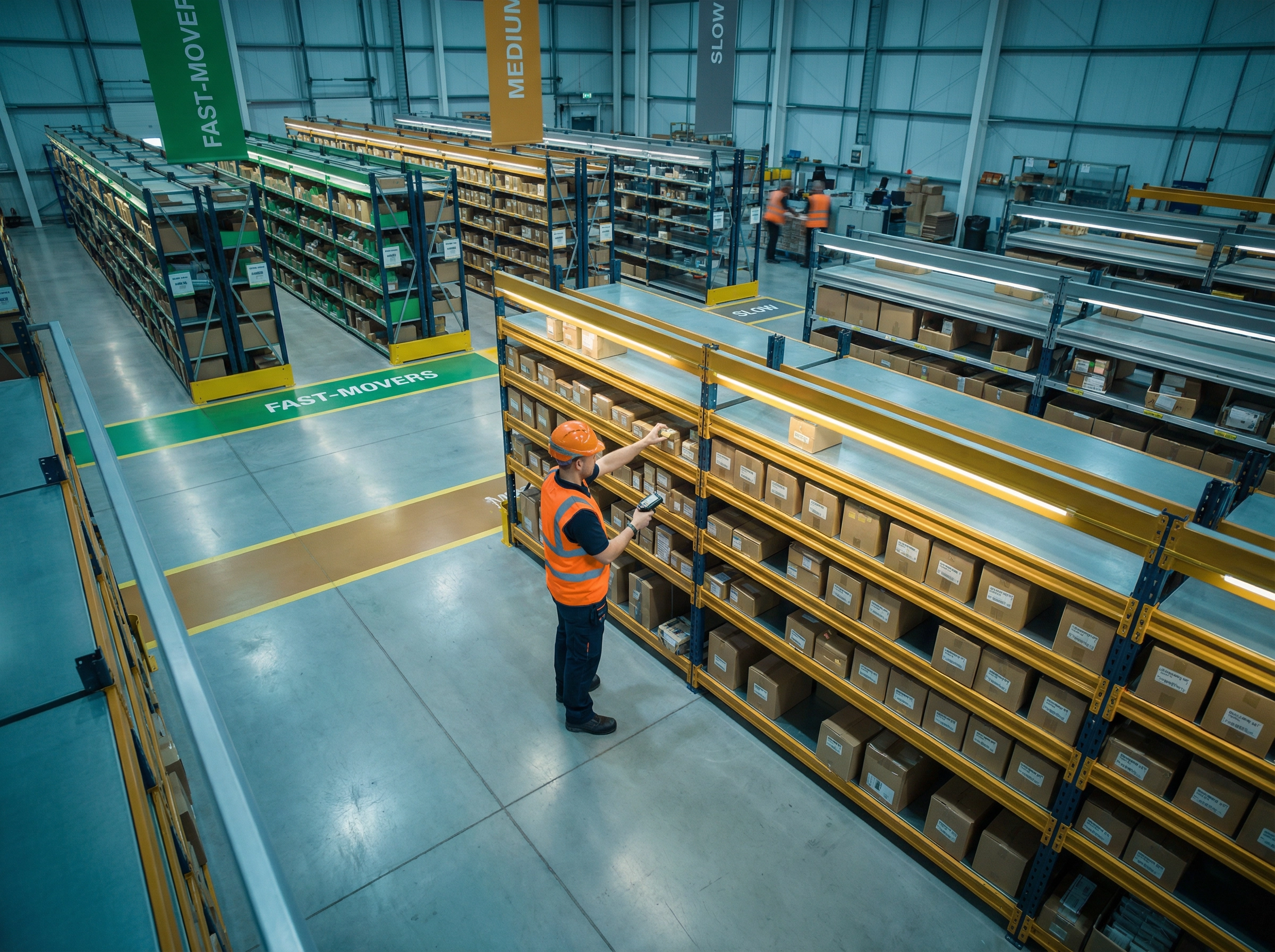
Introduction
Every warehouse manager knows the feeling: pickers walking long distances between locations, fast-moving SKUs buried in back aisles, and slow-moving stock occupying prime real estate near the dock. The result is inflated pick times, higher labour costs, and order fulfilment delays that erode customer satisfaction.
Warehouse slotting — the strategic assignment of products to specific storage locations — is one of the highest-ROI optimisation levers available to operations teams. Done well, it can reduce pick times by 30–40%, cut travel distance by up to 50%, and improve order accuracy without a single additional hire.
This guide covers everything you need to know: the principles behind effective slotting, the analytical frameworks that drive decisions, common mistakes to avoid, and a five-step implementation process you can begin this quarter.
---
What Is Warehouse Slotting?
Warehouse slotting is the process of determining the optimal storage location for every SKU in your warehouse based on factors such as pick frequency, order velocity, product dimensions, weight, and handling requirements. Rather than assigning locations arbitrarily or based on when stock arrived, slotting uses data to place the right product in the right place.
The goal is to minimise the total travel distance and time required to fulfil a typical order. Since labour accounts for 50–65% of warehouse operating costs, and picking represents 55% of those labour costs, even modest improvements in pick efficiency compound into significant savings at scale.
Slotting is not a one-time exercise. Seasonal demand shifts, new product introductions, and changes in order profiles mean that slot assignments must be reviewed and updated regularly — typically quarterly for fast-moving operations and annually for stable product ranges.
---
The Business Case for Slotting Optimisation
The numbers speak for themselves. Research across distribution centres consistently shows that:
| Metric | Typical Improvement After Slotting |
|---|---|
| Pick travel distance | 30–50% reduction |
| Pick time per order | 25–40% reduction |
| Labour cost per unit | 15–30% reduction |
| Order accuracy | 5–12% improvement |
| Picker fatigue / ergonomic incidents | 20–35% reduction |
Beyond cost, slotting directly affects service levels. Faster picks mean shorter order cycle times, earlier despatch cut-offs, and higher on-time delivery rates — all of which are increasingly non-negotiable for B2B and B2C customers alike.
---
Core Slotting Principles
1. The Golden Zone
The golden zone is the storage area between knee height and shoulder height — roughly 60cm to 160cm from the floor. Products stored in this range require minimal bending or reaching, reducing pick time and ergonomic strain. Your highest-velocity SKUs should always occupy golden zone locations.
Above the golden zone (above shoulder height) is suitable for medium-velocity items that can be picked with a step or reach. Below the golden zone (floor level) is appropriate for heavy, bulky items that are easier to lift from a low position, or for very slow-moving stock.
2. Proximity to Despatch
The closer a product is to the despatch area, the less travel time is required after picking. High-velocity items should be slotted as close to the packing and despatch zone as possible. This principle compounds with the golden zone: your fastest-moving SKUs should be in golden zone locations nearest the despatch dock.
3. Product Affinity (Co-location)
Products that are frequently ordered together should be slotted near each other. If 60% of orders containing SKU A also contain SKU B, placing them in adjacent locations eliminates a separate travel leg for the majority of picks. Order affinity analysis — examining co-occurrence rates across historical orders — is the foundation of affinity-based slotting.
4. Physical Characteristics
Slotting must account for product weight, dimensions, fragility, and handling requirements. Heavy items should be slotted at floor level or on lower shelves to prevent injury. Fragile items should be in locations that minimise handling steps. Hazardous materials must comply with storage regulations regardless of velocity.
5. Slot Utilisation
A slot should be sized to hold a standard replenishment quantity without overflow or excessive empty space. Oversized slots waste prime real estate; undersized slots cause frequent replenishment interruptions. Slot sizing analysis — matching slot dimensions to product velocity and replenishment frequency — is a critical but often overlooked component of slotting.
---
ABC Analysis: The Foundation of Velocity-Based Slotting
ABC analysis classifies SKUs by pick frequency or order volume into three tiers:
| Tier | Typical Share of SKUs | Typical Share of Picks | Slotting Priority |
|---|---|---|---|
| A (Fast movers) | 10–20% | 70–80% | Golden zone, near despatch |
| B (Medium movers) | 30–40% | 15–25% | Mid-zone, moderate proximity |
| C (Slow movers) | 40–60% | 5–10% | Outer aisles, upper/lower shelves |
To conduct ABC analysis:
1. Export 90 days of order line data from your WMS or ERP. 2. Calculate total picks per SKU over the period. 3. Rank SKUs from highest to lowest pick frequency. 4. Assign A to the top 20%, B to the next 30%, and C to the remainder. 5. Review the cut-off points — some operations use ABCD classification to create a D tier for near-dead stock.
Repeat this analysis quarterly, as SKU velocity shifts with seasons, promotions, and product lifecycle changes.
---
Advanced Slotting Techniques
Velocity-Zone Slotting
Beyond basic ABC, velocity-zone slotting maps pick frequency to physical zones in the warehouse. The warehouse is divided into zones (typically 3–5) based on proximity to despatch and ergonomic accessibility. A-class items are assigned to Zone 1 (best locations), B-class to Zone 2, and so on.
This approach is particularly effective in large warehouses where travel distance is the primary driver of pick time. A picker who never leaves Zone 1 for A-class orders completes picks significantly faster than one who traverses the full warehouse.
Family Grouping
Family grouping slots products by product category or supplier, so pickers develop spatial familiarity with product locations. This reduces cognitive load and pick errors, particularly for operations with high picker turnover or complex product ranges. Family grouping works best when combined with velocity analysis — fast-moving items within a family should still be in golden zone locations, not buried in the middle of a product group.
Seasonal Slotting
Operations with strong seasonal demand patterns — retail, food & beverage, apparel — benefit from seasonal slotting calendars. Rather than waiting for velocity data to catch up with demand shifts, planned seasonal slot changes are executed before peak periods begin. A Christmas decoration retailer, for example, would move seasonal SKUs to A-zone locations in September, then return them to C-zone after the peak.
Dynamic Slotting
Dynamic slotting uses real-time WMS data to continuously recommend slot changes as velocity patterns shift. Rather than quarterly manual reviews, the WMS flags SKUs whose actual pick frequency has diverged significantly from their current slot assignment. Operations teams then action the highest-priority moves on a rolling basis. Dynamic slotting requires a WMS with slotting analytics capabilities and a disciplined slot-move execution process.
---
Five Steps to Implement Warehouse Slotting
Step 1: Baseline Data Collection
Pull 90–180 days of order line data, including SKU, pick quantity, pick location, and order date. Calculate picks per SKU, picks per day, and order co-occurrence rates. Document current slot assignments and physical zone boundaries. This baseline is the foundation of all subsequent analysis.
Step 2: ABC and Affinity Analysis
Classify all SKUs using ABC analysis. Run order affinity analysis to identify high co-occurrence pairs and groups. Flag any physical constraints (weight, hazmat, fragility) that override velocity-based placement. The output is a prioritised list of SKUs with recommended zone assignments.
Step 3: Zone and Slot Design
Map your warehouse into velocity zones. Define golden zone boundaries and slot dimensions for each zone. Assign SKUs to zones based on ABC classification, affinity groups, and physical constraints. Use a slotting software tool or a structured spreadsheet to manage the assignment matrix for large SKU counts.
Step 4: Slot Move Execution
Execute slot moves in priority order — A-class items first, as they deliver the highest ROI. Schedule moves during low-activity periods (overnight, weekends) to minimise operational disruption. Update slot assignments in your WMS immediately after each move. Communicate changes to pickers via updated pick maps or WMS location data.
Step 5: Measure, Review, and Iterate
Track pick time per order, travel distance per pick, and order accuracy before and after slotting. Set a quarterly review cadence to update ABC classifications and action high-priority slot moves. Document the process so it can be executed consistently by your operations team without external consultants.
---
Common Slotting Mistakes to Avoid
Slotting by product category alone. Grouping all products from the same supplier or category together feels logical but ignores velocity. A fast-moving SKU buried in the middle of a slow-moving product family will consistently underperform.
Ignoring slot sizing. Assigning a high-velocity SKU to a slot that holds only one replenishment unit means constant replenishment interruptions. Slot sizing must account for replenishment frequency and minimum stock levels.
One-time slotting. Slotting is not a project — it is an ongoing process. Operations teams that complete a slotting exercise and never revisit it find that velocity drift erodes gains within 6–12 months.
Optimising for picks only. Slotting affects not just picking but also replenishment, put-away, and cycle counting. A slot assignment that minimises pick travel but creates replenishment bottlenecks may not deliver net benefit. Model the full workflow impact before finalising assignments.
Underestimating change management. Pickers develop spatial memory for product locations. A large-scale slot reorganisation can temporarily reduce pick accuracy and speed as pickers adjust. Phased implementation, clear communication, and updated pick maps are essential.
---
Measuring Slotting Effectiveness
The primary KPIs for slotting performance are:
| KPI | How to Measure | Target Improvement |
|---|---|---|
| Pick time per order line | WMS time-stamp data | 25–40% reduction |
| Travel distance per pick | WMS path data or time-motion study | 30–50% reduction |
| Lines picked per hour | Total lines / total pick hours | 20–35% increase |
| Replenishment frequency | Replenishment transactions per slot per day | 15–25% reduction |
| Pick accuracy rate | Error picks / total picks | 5–12% improvement |
---
How Skuflo Supports Slotting Optimisation
Skuflo's WMS module provides the data infrastructure and analytics tools that make slotting optimisation practical for mid-market operations teams:
Real-time pick velocity data — Skuflo tracks picks per SKU per location in real time, giving operations managers live visibility into which slots are over- or under-performing against their velocity classification.
ABC classification engine — Skuflo's analytics module automatically classifies SKUs by pick frequency across configurable time windows (30, 60, 90, 180 days), flagging SKUs whose velocity has shifted and recommending slot review.
Slot move workflow — When a slot move is recommended, Skuflo generates a prioritised move list, guides warehouse staff through the move sequence, and updates location data in real time as moves are completed.
Order affinity analysis — Skuflo analyses co-occurrence rates across historical orders to identify high-affinity SKU pairs, enabling affinity-based slotting decisions without manual data manipulation.
Integration with ERP and 3PL systems — Skuflo connects to your existing ERP and 3PL platforms, ensuring that slot assignments are reflected consistently across all systems that drive pick instructions.
---
Frequently Asked Questions
How long does a warehouse slotting project take? A full slotting analysis and implementation for a warehouse with 2,000–5,000 SKUs typically takes 4–8 weeks: 1–2 weeks for data collection and analysis, 1–2 weeks for slot design, and 2–4 weeks for phased slot move execution. Ongoing quarterly reviews take 1–2 days per cycle once the process is established.
Do I need specialist software for warehouse slotting? For warehouses with fewer than 500 SKUs, a structured spreadsheet approach is viable. Above 500 SKUs, a WMS with slotting analytics capabilities — or a dedicated slotting tool — significantly reduces the time and error rate of the analysis. Skuflo's WMS module includes slotting analytics as a standard feature.
How often should I re-slot my warehouse? Most operations benefit from a full slotting review quarterly, with high-priority moves actioned on a rolling basis between reviews. Operations with strong seasonal demand patterns should conduct a seasonal slot review 6–8 weeks before each peak period.
What is the ROI of warehouse slotting? ROI varies by operation, but most mid-market warehouses achieve payback within 3–6 months of a slotting implementation. The primary value driver is labour cost reduction from faster pick times. Secondary benefits include reduced replenishment costs, lower ergonomic incident rates, and improved order accuracy.
Can slotting help with multi-channel fulfilment? Yes. Multi-channel operations — serving both B2B bulk orders and B2C single-unit orders — benefit from zone-based slotting that separates high-velocity B2C SKUs from bulk B2B pick locations. This prevents congestion in high-traffic zones and allows pick strategies to be optimised per channel.